Mic Check Poet Profile: Ralph Bryant
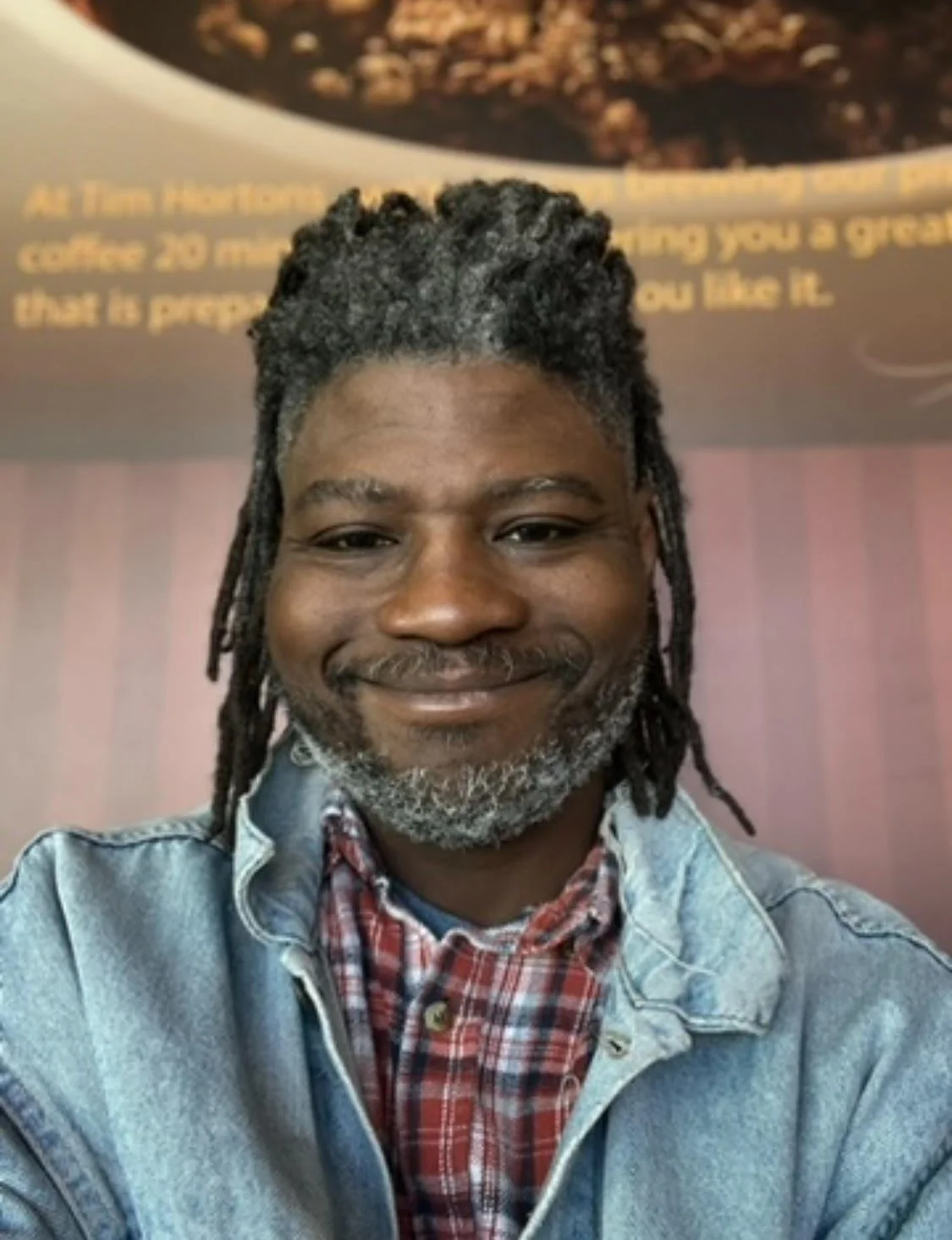
Ralph Bryant and the Courage to Heal Loudly
By: Chey Wright | IDIC Verse
July 20, 2026
Ralph Bryant spent years saying things through poetry which he could not yet say anywhere else.
Before the microphone, before the documentary recordings, before handwritten affirmations began appearing across Winnipeg, there was the page—a private place where Bryant could approach emotions, he did not always have the language or courage to express aloud. “Through poetry, I could say things or express things I would have been afraid to express otherwise,” he told me.
Bryant is a writer, filmmaker and multidisciplinary creative who grew up in the Bronx and has lived in Canada for nearly two decades. His relationship with writing began at eight years old, while home from school with chickenpox. Surrounded by the soap operas his mother watched during the day, he wrote one starring his teachers and classmates. His teacher liked it enough that the class performed it. The assignment revealed something Bryant already seemed to understand instinctively: he wanted to be a writer.
“There is nothing else I really have wanted to be, ever.”
Poetry became the form through which he conveyed emotion, but for much of his life, Bryant did not consider himself a performance poet. The work felt too exposed. His poems contemplated experiences he was still learning how to name outside of writing, making the thought of sharing them publicly feel almost impossible.
That relationship began to change after Bryant was hospitalized for psychiatric care in 2018. He describes the years since as a period of reconciliation and reflection—a process of separating who he truly wanted to be from the narratives culture, history and shame had taught him to accept. Bryant is the third generation of his family to experience psychiatric hospitalization, and he speaks about mental health as both deeply personal and inseparable from larger social systems.
He has also spent much of his life carrying shame around being queer. Healing, for Bryant, has meant questioning ideas about himself that once felt permanent simply because he had believed them for so long.
“The last few years… have really been challenging all of these beliefs that I have about myself that are not really rooted in anything,” he said. “They’re just rooted in the narratives that I believed.”
One of those beliefs was that he did not belong onstage.
A few years ago, Bryant performed at an open mic for the first time. In speaking his poetry aloud, he discovered something new within a voice he had been developing since childhood. Performance expanded not only how he understood his writing, but how he understood himself—as an artist, a poet, and a member of a community. Still, he resists fitting neatly inside the conventions of slam. Bryant admires the form, but his poems tend to sprawl beyond its three-minute limit.
“I don’t want to think in three minutes,” he said. The tension is fitting for an artist whose work continually expands beyond its original boundaries.
His ongoing documentary project, On the Verge, began with his experiences of mental illness and hospitalization. It has since grown into an exploration of the generational effects of scientific racism and pseudoscience on Black communities and other racialized people. The project incorporates recordings Bryant made around the time of his hospitalization, placing his personal story alongside a longer history of systems that have frequently misunderstood, pathologized or harmed Black people. His research has taken him as far back as Drapetomania, the racist nineteenth-century theory that described enslaved people’s desire to escape captivity as mental illness. For Bryant, examining that history is necessary to imagining something better.
“We know that those systems, like most systems, were not built for us to thrive and exist in those spaces,” he said. “How do we understand, so that we can build a system that works for everyone?”
The first part of On the Verge is planned as a long-form podcast. It will combine Bryant’s present-day reflections with recordings made before and after his hospitalization, grounding the larger investigation in his own voice. Although the project holds space for suffering, Bryant is equally interested in what he calls “the promise of mental health”—what becomes possible when people are allowed to speak about healing without shame. He imagines a world where “everyone, everywhere, every day can heal loudly together.” That idea also lives in the Love Notes Campaign.
During his hospitalization, Bryant began writing affirmations on a whiteboard above his bed. By the end of his two-week stay, the board was covered. Several years later, while meditating on a mountain in Northern California, he found himself thinking again about the power of one person offering another a message of love, acknowledgement, or encouragement. After moving to Winnipeg, he filled a sketchbook with affirmations. Once every page had been used, he began tearing them out and placing the messages around the city—on telephone poles, in coffee shops and anywhere a stranger might unexpectedly find one.
The project initially gave Bryant a way to learn Winnipeg while creating some emotional distance from the intensity of his documentary work. It soon grew into a wider community initiative. After inviting people to submit their own affirmations, Bryant and several volunteers placed approximately 150 love notes throughout Winnipeg for World Mental Health Day. The notes may not resemble poetry in the traditional sense, but they emerge from the same belief that has shaped Bryant’s writing since childhood.
“It is certainly words,” he said, “and the power of words.”
That power, in Bryant’s work, is rarely individual. Alongside his writing and filmmaking, he works at the Rainbow Resource Centre and is involved with the Black Film Collective, Black History Manitoba and the Black Canadian Experience Centre. He sees community involvement not as something separate from creative practice, but as part of the same responsibility.
“That’s our responsibility and our accountability to each other.”
Since moving to Winnipeg, Bryant’s poetry has increasingly explored who he is as a Black and queer person in the city. He writes about mental health and love, but also about the ways place can alter our understanding of identity. Winnipeg’s particular diversity, he said, has helped him redefine what Blackness and queerness mean within his own life.
At his upcoming Winnipeg Poetry Slam feature, Bryant hopes to express the full range of who he is as a poet. Choosing what to perform has been difficult, especially for a writer whose poems resist brevity. During our conversation, however, he kept returning to one piece. It began when Bryant was unable to unlock another creative project. Frustrated, he started writing about his inability to make the thing he wanted to create. Several pages later, he realized the frustration had become its own poem—one about the darkness of creation and, as he would understand later, mental health. It is one of his most important pieces, and one he has never shared publicly.
“If I had to express myself as one piece,” he said, “that would be the piece.”
There is something fitting about Bryant preparing to speak publicly through a poem born from feeling creatively trapped. His work repeatedly transforms one form of confinement into another form of possibility: a hospital whiteboard becomes a city full of affirmations; private recordings become documentary; emotions once held quietly on the page become a voice in the room.
Ralph Bryant’s art does not pretend that words can repair everything.
It asks what they might begin.
A sentence above a hospital bed.
A note waiting on a telephone pole.
A poem finally spoken aloud.
Not healing hidden.
Healing heard.
Loudly.
Originally from New York City, Ralph Bryant is a queer writer, father, and mental health advocate who has lived in Canada for almost 20 years.
He has published three books of poetry, and his quest for healing and spiritual growth across North America is what bought him to Manitoba, where he is currently working on a new poetic project about his time living in Winnipeg. He has performed for the Canadian Museum for Human Rights, Black History Manitoba, and Pride Winnipeg, and has competed in the Winnipeg Poetry Slam.
Ralph is also the creator of the Love Notes Campaign, which transforms public spaces into canvases of compassion, using positive affirmations to elevate mental health awareness in Winnipeg, throughout Manitoba, and beyond.
In his “spare time,” Ralph is the Manager, Stewardship and Philanthropy at Rainbow Resource Centre.