Mic Check Poet Profile: Scott Nolan
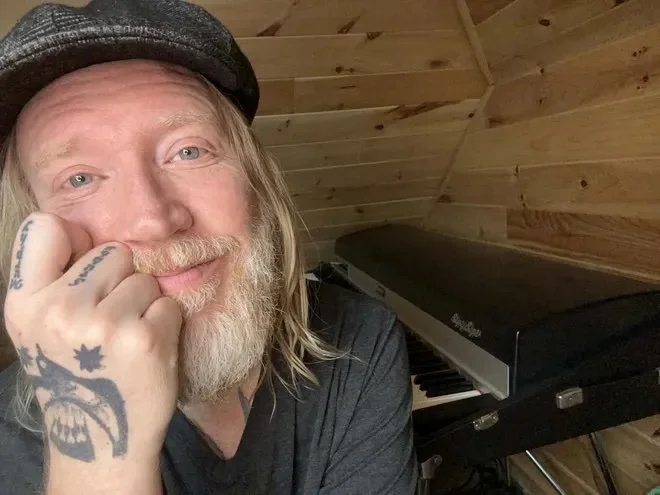
Scott Nolan and the Art of Paying Attention
By: Chey Wright | IDIC Verse
May 11, 2026
Some artists talk about creativity like it is a career. Scott Nolan talks about it like it is something woven into the fabric of everyday life, something constantly waiting to be noticed.
When I asked Nolan what small thing recently reminded him why he still makes art, he pushed back on the idea of “small” entirely. To him, even ordinary moments carry weight. During one of his daily walks, he spotted a jack of diamonds folded upright on the sidewalk “like the peak of a house.” He pulled out a polaroid app on his phone and captured it immediately. Another day it might be clouds shifting shape overhead. Another day it might be the movement of strangers across a bridge.
“Everything makes me think of art,” he told me. “I marvel at it.”
That sense of attention runs through everything Nolan creates. Whether through song writing, poetry, photography, or live performance, his work often feels less about invention and more about noticing. Winnipeg is not simply a setting in his work. It breathes through it. The city shows up in ditches full of rainwater, footbridges, side streets, winter cold, and the strange intimacy of people moving through public space together. Nolan will be the featured poet at Winnipeg Poetry Slam’s Open Mic Night on May 26th at The Handsome Daughter, bringing with him a voice shaped by decades of song writing, observation, and artistic curiosity.
During our conversation, Nolan described art almost spiritually, not in a rigid religious sense, but in the way it connects him to something larger. He spoke warmly about the Indigenous word “Creator,” explaining that he always appreciated its openness and lack of hierarchy. For him, art feels tied to that same impulse. Not something distant or elite, but something alive in the world itself. As he has gotten older, he said, that relationship has only gotten stronger. Art stopped feeling like a hobby long ago; it became something closer to responsibility. “It becomes a thing I feel like I live in service to,” he said.
That commitment exists despite all the things that can pull artists away from their work: exhaustion, cynicism, financial pressure, technology, audience expectations, or the endless chase of recognition. Nolan spoke candidly about how dangerous fame can become when artists begin measuring their value through visibility rather than honesty. Referencing Vincent Van Gogh, he reflected on how some of the most powerful art exists completely outside applause while it is being created. “I wonder if fame isn’t a bit of an artistic disease,” he admitted.
That philosophy of attention extends into the way Nolan talks about Winnipeg’s artistic community. When I asked why the city seems to produce artists who stay so connected to one another, he pointed to something he believes separates Winnipeg from larger cultural centres: artists here actually pay attention to each other. He described reaching out to artists he admired when he was younger—people like John K. Samson, Catherine Hunter, and Guy Maddin—and being surprised that they actually answered him. Not as untouchable figures protecting status, but as working artists willing to encourage someone coming up behind them.
“That’s a Winnipeg thing to me,” he said.
Rather than treating younger artists as competition, Nolan sees Winnipeg artists watching one another with genuine curiosity and support. The community functions less like a hierarchy and more like an ongoing conversation stretching across generations.
Place itself also plays a major role in Nolan’s work. When I asked what part of Winnipeg feels most emotionally tied to his writing and music, he answered immediately: Charleswood. He grew up there after his family moved across the river into what he described as a middle-class suburb filled with green space, ditches, and room to roam. He spoke about spending enormous amounts of time in Assiniboine Forest and wandering through neighbourhoods that still carried traces of rural Manitoba. “There was a lot of room for imagination in that neighborhood,” he said. That imaginative space still exists in his work now, though Nolan seems just as interested in present-day Winnipeg as memory. Some of his strongest stories come from simply observing people around him.
At one point, he described walking toward a footbridge when he noticed a man pacing in a long coat, arguing loudly into a flip phone in another language while, only a few feet away, a woman in a thin black dress moved silently with the wind “like a ballet” who the man never once acknowledged. Nolan stopped in his tracks watching the contrast unfold. Moments like that often-become poems for him. Unlike song writing, which he says involves more structure and revision, poetry arrives quickly for him, almost instinctively. He compared it to capturing something before the brain has time to interfere or reshape it. “The better poems feel like something I saw and recorded,” he explained.
That immediacy is part of why spoken word poetry fascinates him, even if he hesitates to fully claim the title of poet for himself. Nolan repeatedly downplayed his own authority when discussing poetry mechanics or formal education around the craft, though his admiration for poets was obvious throughout the interview. When the conversation shifted toward Shane Koyczan, Nolan lit up instantly. He spoke about watching seasoned musicians openly cry during one of Koyczan’s performances at a major folk festival, describing the experience with the excitement of someone still genuinely moved by art after decades inside artistic communities.
“They had no idea what was coming,” he said, laughing.
For Nolan, artistry is not about technical perfection alone. It is about emotional honesty. Presence. The willingness to say something real without sanding down its edges first. “The job is actually to be creative,” he said at one point. “That inner barometer—that’s what matters.”
Throughout our conversation, Nolan kept returning to the idea of attention. Not just as artistic practice, but as survival. He spoke openly about anxiety, loneliness, and the feeling of being failed by education systems that never recognized creative potential in him when he was younger. Poetry and song writing became ways of enduring difficult periods in his life long before they became public-facing work. One of the most striking moments in the interview came when Nolan talked about his cousin, who became a poet while incarcerated in solitary confinement after reading Viktor Frankl and Martin Luther King Jr. in prison. Nolan spoke about him with deep admiration, not because of publication or prestige, but because creativity emerged under impossible circumstances.
“He became a poet in a cage,” Nolan said quietly.
That story seems to sit near the centre of how he understands art itself. Not performance for validation, but expression as resilience. As proof that people can still create meaning under pressure. That same philosophy is part of what makes spaces like Winnipeg Poetry Slam matter. Beneath the scores, performances, and applause is something much simpler: people trying to connect honestly for a few minutes at a microphone. Nolan understands that instinct well.
His feature performance on May 26th at The Handsome Daughter will likely move between storytelling, poetry, reflection, and the kind of observational warmth that defines much of his work. Listening to him speak feels a little like walking through Winnipeg beside someone who notices details most people pass without seeing: a folded playing card on concrete, a stranger dancing in the wind, a city constantly speaking to anyone willing to pay attention long enough to hear it.
For Scott Nolan, attention is not passive. It is its own form of love.
Scott Nolan is an acclaimed songwriter, multi-instrumentalist, producer, poet, and visual artist from Winnipeg, Manitoba, Treaty One Territory. Learn more about him at scottnolan.ca