Winnipeg Poetry Slam: Louder Than You Think
Inside Winnipeg’s Poetry Slam Scene
By: Chey Wright | IDIC Verse
April 19th, 2026
Let’s clear something up right away: a poetry slam is not a quiet room where people politely clap and then go home unchanged.
It’s louder. It’s a little chaotic. And more often than not, it’s way more fun than people expect.
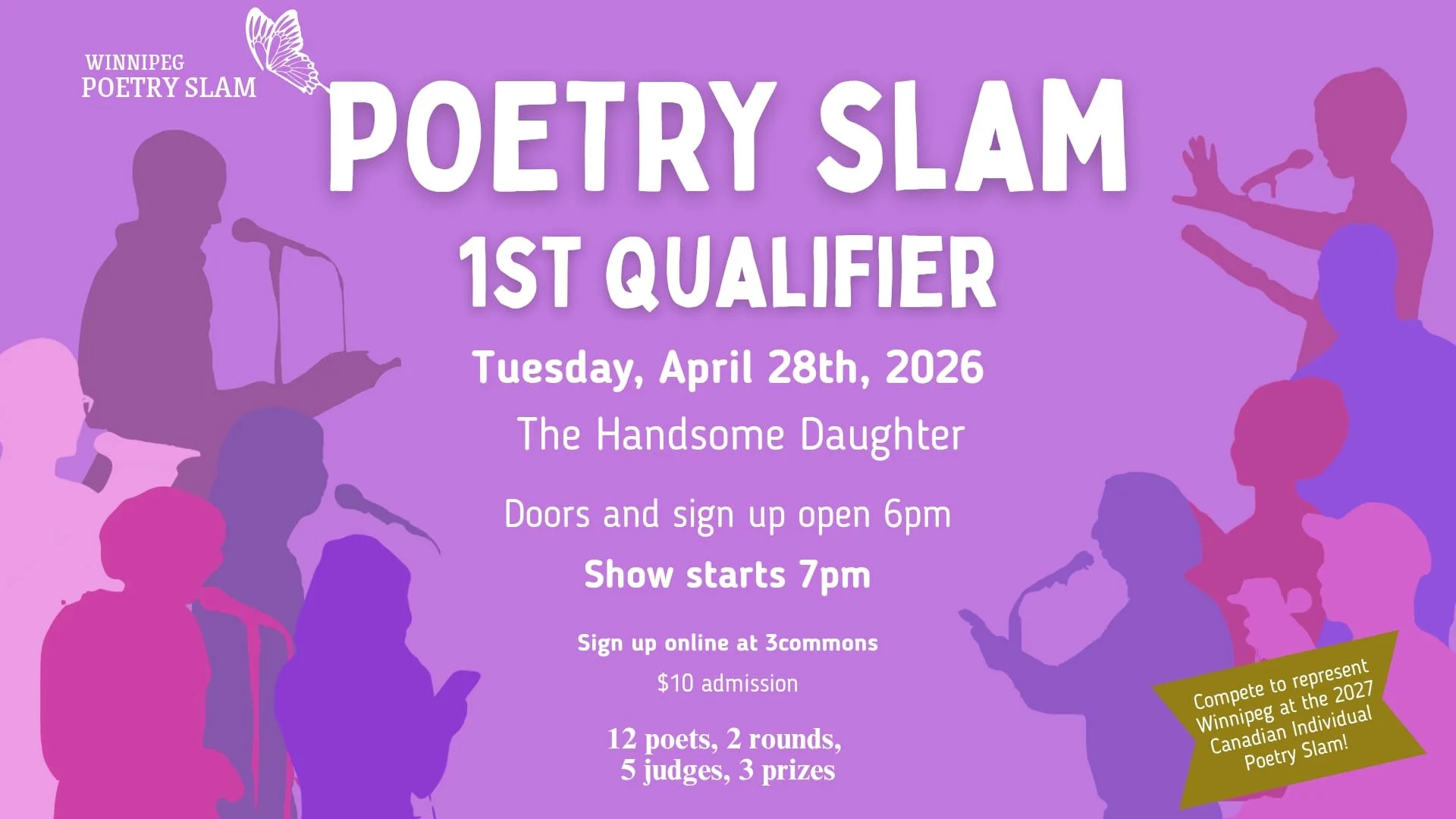
The Winnipeg Poetry Slam is back for a new competitive season at The Handsome Daughter, with Slam Qualifiers taking place April 28 and June 30, leading into the finale on August 25. On the Tuesdays in between, the stage opens up for Open Mics, which means even more chances to perform or just show up and see what happens.
If you’ve ever been curious about slam, this is a good place to start.
So… What Actually Happens?
At its core, a poetry slam is a live performance competition.
Poets perform original work, and five judges—pulled randomly from the audience—score each performance from 0 to 10. The highest and lowest scores are dropped, and the remaining three are added together for a total out of 30.
The judging is part of the fun—and sometimes part of the drama. If a score feels too low, don’t be surprised if someone in the crowd yells “HIGHER!”
It doesn’t change anything, but it does feel good.
But before any of that begins, there’s a tradition where a “sacrificial poet” volunteers to go first and perform a piece whose score is not counted towards the competition. It helps the judges settle in and gets the room warmed up. It also requires a certain level of bravery that the rest of the room tends to appreciate.
How the Night Works
The slam runs in two rounds.
In the first round, 12 poets who signed up are selected in random order to perform. After scores are tallied, the top six move on. Then there’s a short intermission where people grab a drink, talk about the scores, and poets quietly prepare for round two.
In the second round, those six poets return with a new piece. That round determines the top three for the night. In qualifier events, only the second-round scores count toward final placement, so what you bring in that final round really matters.
Each poet has three minutes and a 10-second grace period. No props, no costumes, no musical accompaniment. Just the poet, the mic, and their words.
And yes, you can read your poem—from memory, a notebook, or your phone. Just don’t refer to it in the performance itself or it will count as a prop violation.
Thinking About Performing?
There’s no special requirement to sign up.
You show up early, put your name down on the sign up list, and wait for it to be called for your turn. First-timers and experienced poets all go through the same process, which means you could be on stage first, last, or anywhere in between.
Just as important—this is a space that’s meant for everyone.
No matter your age, background, identity, or experience level, you are welcome to step up to the mic. That openness is part of what makes slam what it is. At the same time, there’s a clear expectation that the space stays respectful. Hate speech directed at any group isn’t tolerated—and crossing that line means you won’t be invited back.
And if you’re nervous, that’s normal.
That mix of fear and excitement shows up again and again.
“I was so nervous I couldn’t stand up,” says Squigs, Winnipeg Poetry Slam’s 2013 Slam Master. “You could barely hear my voice over the sound of the trembling paper in my hands. Though afterwards, I was on such a high for which I have yet to come down from.”
Janelle Lagasse remembers something similar. “Terrified. Exhilarated. My hands were shaking,” she says. “But once I started speaking it was like an exhale.”
Even when expectations don’t quite line up with reality, something about the experience sticks.
“I thought my poem was so good… until I heard the people go on before me,” says Jessica Smithies. “But I was hooked. I’ve never had that many people listen to what I had to say before.”
The Handsome Daughter (and Milton)
The slam takes place at The Handsome Daughter, located at 61 Sherbrook Street in Winnipeg. It’s a smaller venue, which works in its favour. The room fills up, the crowd gets close, and every performance feels intimate.
And then there’s Milton.
Milton is the Winnipeg Poetry Slam’s stuffed pig mascot. He has fairy wings, and he is taken very seriously.
If you win, you get to celebrate on stage with Milton. You can hoist him up, take your moment, and enjoy the glory.
You don’t get to keep him, though. Milton belongs to the Winnipeg Poetry Slam. You just get your moment with him—and honestly, that’s kind of the point.
Why People Keep Coming Back
The competition is only part of it.
For many poets, slam is about having a place to speak and be heard.
“It gives me a voice. That’s a powerful gift to give someone,” says Jessica Smithies.
It’s also about the people.
“The slam is truly a supportive community based on a shared love of an art form,” says Rudy Rempel, also known as One of the Many. “Everyone involved wishes for all to succeed in speaking their truth to a supportive crowd.”
That support shows up quickly, especially for new performers.
“You won’t find a more supportive crowd than this one,” Rudy adds. “First timers are routinely given extra support and encouragement.”
Advice from Seasoned Slam Poets
If you’re thinking about signing up, you’re not alone. Here’s what some regulars have to say:
“Breathe. You’ll be okay. Everyone here wants to hear what you have to say,” says Janelle Lagasse. “You are important. Your words and your work are important.”
Jessica Smithies puts it this way: “Have fun. At the end of the day, art is a form of play… Do it scared. It’s worth it. I promise.”
Squigs keeps it practical: “Pick a stage name.”
And from One of the Many: “Summon up your courage and get on stage. You won’t find a more supportive crowd than this one.”
What If You’re Just Watching?
That’s half the experience.
You don’t need to know anything about poetry to enjoy a slam. You just need to react. Laugh when something is funny. Cry if words pull at your heartstrings. Snap your fingers when something lands. Say “HIGHER!” when you feel strongly about a score.
And if you end up judging, go with your instincts. That’s exactly how it’s supposed to work.
Final Thoughts
A poetry slam is hard to fully understand until you’re in the room.
It’s a little unpredictable. Not every poem will land for you, but at some point in the night, someone will say something that sticks.
As Squigs describes it, slam is “a place where almost anyone is welcomed to share their words and receive immediate reciprocation.”
That kind of space is worth checking out.
Winnipeg Poetry SlamEvent Details
Location: The Handsome Daughter, 61 Sherbrook Street, Winnipeg
Slam Qualifier 1 - April 28
Open sign-up, 12 spots
Slam Qualifier 2 – June 30
Featuring award winning slam poet Lucia De Luca!
Open sign-up, 12 spots
Grand Slam Championship – August 25
Featuring Governor General’s Literary Award winner katherena vermette!
Competition by invitation = 12 ranking finalists
The winner qualifies to compete at the 2027 Canadian Individual Poetry Slam in Vancouver!
Admission = $10
Visit 3Common for advance tickets with fees. 10 pre-sign up spots available.
Or at the door with cash. 2 walk-in sign up spots available.
Open Mics take place on off months throughout the season. Visit our homepage for scheduling info.
If you’re looking for something different to do on a Tuesday night, this might be it. And if nothing else, you’ll leave understanding why people keep coming back.